


A retired family estate car rolls through the factory gate for the last time. Car disposal is the starting signal. After a few hours, only single-grade metal fractions, plastics and a bag of fine fluff remain. Automobile recycling is a complex, highly developed multi-stage process: it begins with legally compliant car disposal – deregistration, recovery certificate, collection – and leads to single-grade recovery via dismantling, pre-shredding and sorting. A company like ARJES plays a central role in this with its shredding solutions.


two-shaft shredders explained in simple terms
Concentrated shredding power for metal scrap – the new EuRec FERRO 950
Density separation using the float-sink process and NIR detection produces usable plastic and rubber fractions with clear quality characteristics.
Post-shredder metal recovery (sensor/X-ray sorting) lifts aluminium, copper and stainless steels. Similar processing and utilisation concepts can also be found in concrete recycling, where mineral fractions are separated by type and fed into high-quality reuse, even from fine-grained ASR streams.
Utilise high-calorific light fraction as substitute fuel in cement plants; pre-treatment, dedusting and documentation ensure stable acceptance.
Process data monitoring (mass balances, calorific value, contaminants) creates planning security, improves marketing and reduces disposal costs. In car disposal, considerable residual fractions accumulate, the treatment of which reduces rejects and secures revenues.
If the entire annual ASR quantity were filled into freight containers, it would result in a freight train from Frankfurt to Barcelona.
The multi-stage recycling process in detail
Depollution
Dismantling
Pre-shredding
Sorting
This is how a worthless wreck becomes a sought-after bundle of secondary raw materials for steelworks and plastic processors. Metallic fractions are the backbone of scrap recycling; tyre streams run in parallel in tyre recycling.
From end-of-life vehicle to fraction – process chain when shredding vehicles
Overview of typical materials:
Fuels, engine and transmission oil, brake and coolant are suctioned off, filtered and collected in certified tanks for further recycling.
Pyrotechnic airbag gas generators are pre-ignited or neutralised with special tools to prevent any risk of explosion during subsequent shredding.
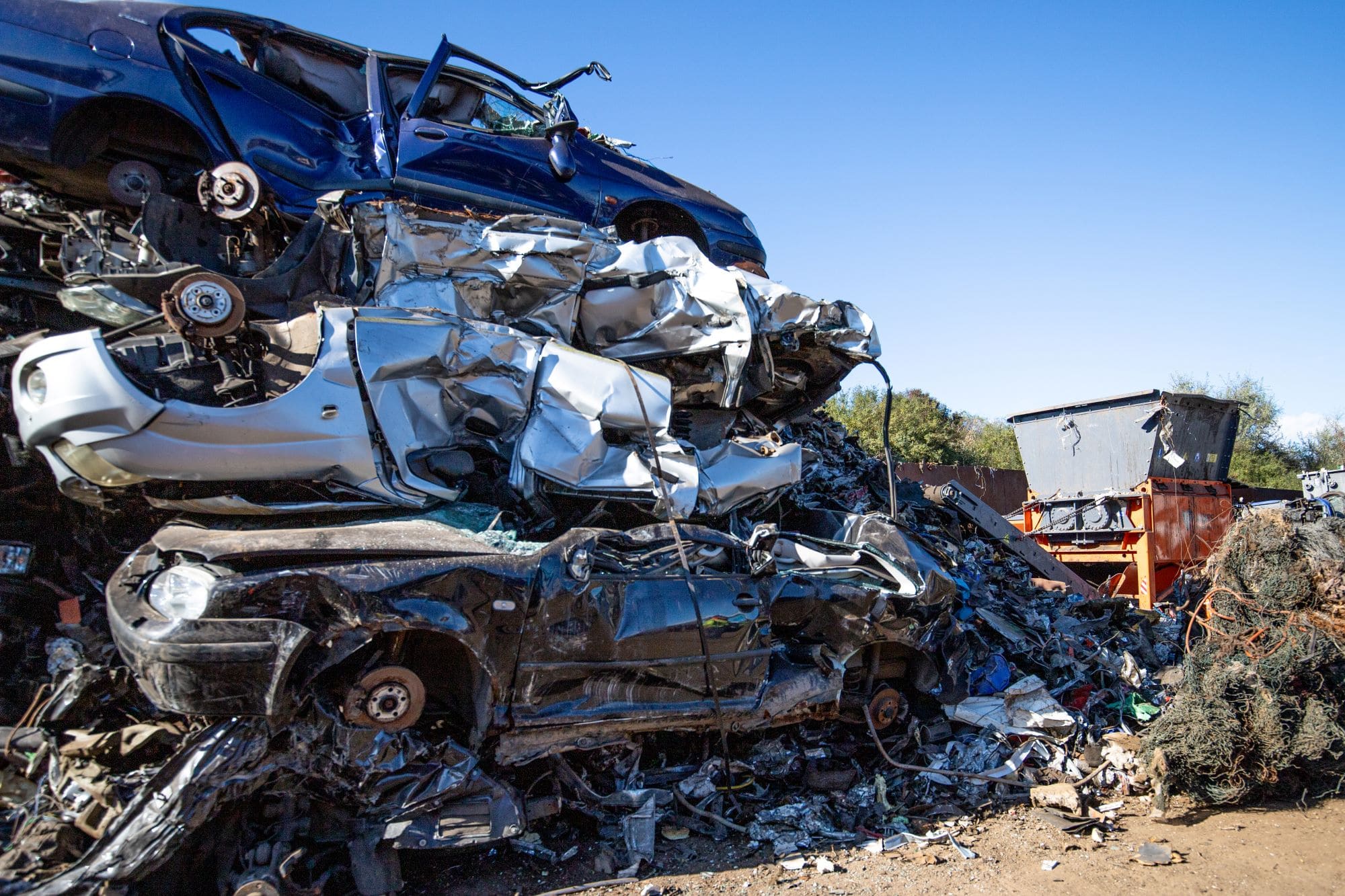
bodies, engine blocks, axles and all remaining components are significantly reduced in volume.
ferrous metals, non-ferrous metals and light fractions are separated; residual materials can be treated in a targeted way.
Specify vehicle shredders properly, market fractions better
Components such as engines, transmissions or catalytic converters achieve high margins on the used parts market. Non-reusable metal parts go directly into scrap recycling; electrics and wiring harnesses go into e-waste recycling. Dismantling is a core step in car disposal.
Average prices for used vehicle components:
Used car engines usually fetch €800 - €2,500 depending on mileage, displacement, brand and warranty; rare performance units achieve significantly higher prices on the spare parts market.
Fully functional transmissions for common models often fetch between €400 and €600, including a short warranty from the dealer.
Catalytic converters with a high precious metal content reach prices of up to €250 in the recycling market, depending on the platinum, palladium and rhodium content.
Alternators in good condition are traded for around €80, particularly in demand for classic car restorations and commercial vehicle workshops.
Service-friendly design and power options – ready for any job
For this step, ARJES relies on the TITAN class with the mobile and stationary 950. New to the market and specifically designed for demanding applications with a high ferrous content is the EuRec FERRO 950 two-shaft shredder. With a reinforced design, a powerful shredding system and an integrated magnetic drum for separating ferrous and non-ferrous components, it is suitable for extremely resistant material streams such as end-of-life vehicles and metal scrap.
Sorting – Magnet, Eddy Current, Wind
Overview of separation processes:
Magnetic separators reliably remove ferromagnetic steels, stabilise the process flow and deliver high purities for steelworks, foundries and downstream quality controls worldwide.
Eddy current separators eject conductive light metals such as aluminium from the material stream; variable rotors and screen lines noticeably and sustainably increase yield, recovery and marketability.
Air classifiers separate light fractions such as foams and foils from heavy particles; adjustable airflows create homogeneous fractions and optimise calorific value and dedusting.
Sensor-based sorters (NIR, XRT, colour recognition) selectively lift plastics and mixed metals; tightly set grain bands significantly improve yields, product quality and revenues.
Results are continuously verified via mass balances and laboratory samples. This keeps qualities constant and builds trust with customers. At the same time, disposal costs decrease because fewer unsorted residual materials accumulate.
Car Disposal – Process, Proof, Costs
- Recovery certificate from a certified dismantling company; basis for deregistration with the registration authority.
- Collection and logistics depending on availability; free accessibility, keys and vehicle documents accelerate the handover.
- Costs or possible revenues depend on condition, completeness, metal content and market situation.
- Complete documentation of material flows; legally compliant handover of the complete vehicle.
The following three subsections explain the essential steps of car disposal in detail.
Deregistration & Recovery Certificate
Collection & Logistics
Costs & Possible Revenues
E-Vehicles & Batteries – New Challenges, New Opportunities
The growing proportion of e-vehicles requires additional safety steps in car disposal. High-voltage batteries are removed before shredding and temporarily stored in fire protection containers. The EU is discussing minimum quotas for secondary lithium, nickel and cobalt in new vehicles – an additional business segment for recyclers. Power electronics and wiring harnesses are transferred to e-waste recycling streams to recover high-quality metals and plastics. These steps are an integral part of responsible car disposal.
Regulatory Boost 2025 – The New EU ELV Package
Conclusion – Car Disposal: Think Circular, Secure Value Creation
Car recycling has long been high-tech. With robust pre-shredders from ARJES and EuRec and other systems, recycling rates close to the 95% mark can be achieved today. The upcoming EU regulations and the e-mobility boom increase the pressure, but at the same time open up new material and service markets.
Thus, car recycling is not just a technical process, but an investment in sustainability and economic efficiency (similar to paper production). It offers tangible benefits for vehicle owners who get spare parts cheaper, for workshops that can react flexibly and quickly, and for our planet, because existing resources are conserved and raw material cycles are closed. Legally compliant car disposal forms the starting point for this: deregistration, recovery certificate and predictable collection interlock and lead directly to dismantling and shredding. This reduces downtimes, keeps disposal costs manageable and makes higher revenues from secondary parts more likely.


